Cascading Echoes: The Step Most People Skip
Most people build their statement pieces and stop decorating their garland. Their porch still looks good. It just doesn't have the thing that makes you slow down when you drive past. Cascading echoes are the finishing touch, and they take about fifteen minutes. This is layer three in the layered porch garland.
What is a Cascading Echo?
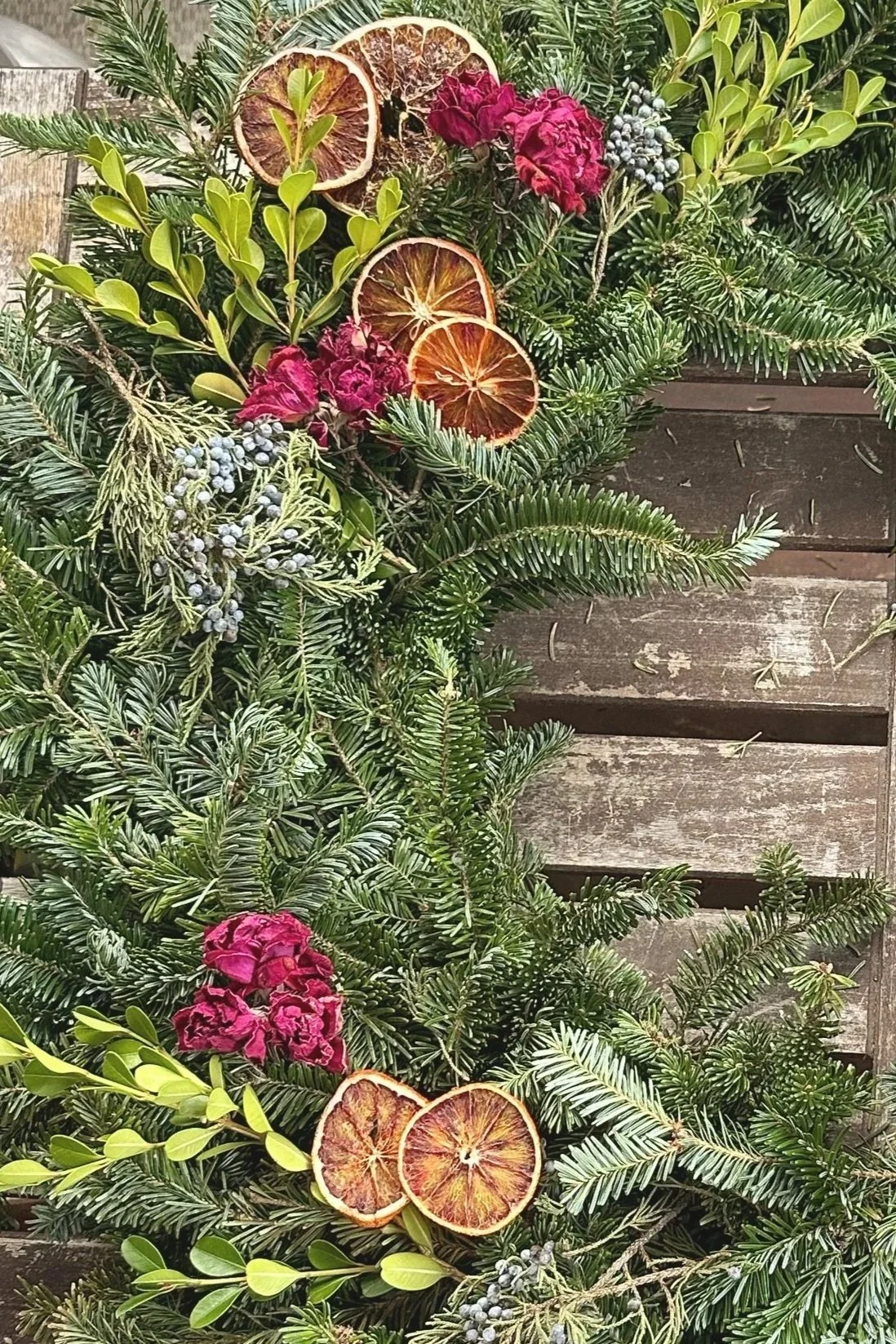
A cascading echo is a smaller cluster that mimics your statement pieces and repeats it at a reduced scale down the garland. Same materials and color scheme as your centerpiece bow or your corner anchors—but smaller. These carry your eye from one statement to the next without competing with either one. Without them, a garland reads as two or three decorated spots with empty greenery in between. Learn how to build ornament clusters as your corner anchors here.
Before you get started, don’t forget all the boring supplies you’ll need to finish—from floral wire and zip ties to command hooks and a hammer.
The Scaling Rule: One Third
Whatever size your statement cluster is, your echo is roughly a third of it. If I used nine ornaments in my corner anchor clusters, my cascading clusters use three. If the anchor has one extra large ornament, the echo's largest piece is a medium. This ratio is what keeps the echo a supporting piece. Go bigger and you've built a third statement point that fights with the other two. Go smaller and it disappears from the street.
The Spacing Rule: Widen As You Go
As the echoes cascade away from your statement piece, widen the space between each one. Start close to the anchor and space them progressively farther apart as they move down. Three or four echoes per run is usually plenty. Why it matters: evenly spaced clusters read as a pattern, and a pattern reads as manufactured. Widening spacing reads as movement—like the arrangement is trailing off naturally rather than being placed at intervals.
The Placement Rule: Avoid Symmetry
Follow the drape. Place echoes along the natural downward curve of the garland, not fighting it.
Vary the depth. Push some in deep, let others sit forward. Same rule as the anchors.
Alternate the side. Don't run every echo along one side. Move some to the left and some right, so your eye zigzags down instead of tracking a straight line.
Stop before the end. Let the last few feet of garland be mostly greenery. That empty space is what makes the decorated parts read as intentional.
What to Use
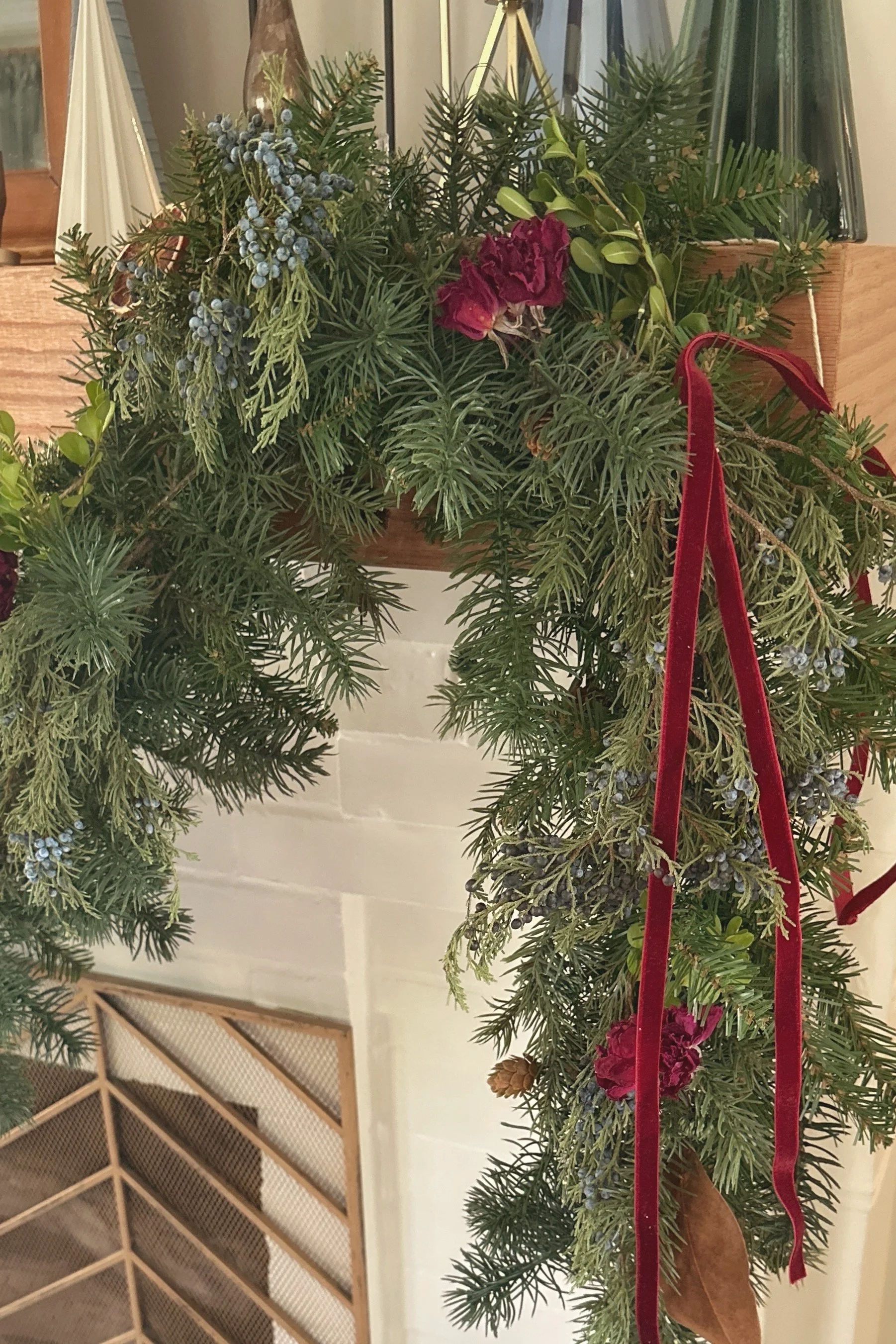
Echoes are where I bring in smaller ornaments and the natural materials that soften everything. Pull directly from your statement clusters' materials. An echo made of new materials isn't an echo; it's a fourth idea.
Some examples:
Dried orange slices — warm, translucent, and they glow when a light is behind them.
Purple beautyberry stems — my favorite way to pull in more natural color.
Small ornaments from the same family as your anchors.
Dried florals — hydrangea, roses, anything already in your color story.
What’s Next? Connect Everything with Ribbon
The statement pieces anchor, and cascading echoes provide movement. Ribbon is what ties the whole thing together into one visual line. Step by Step guide is here: How to Add Ribbon around Ornaments.
Some of the links in this post are affiliate links, which means I may get a small commission if you make a purchase—at no additional cost to you. As an Amazon Associate I earn from qualifying purchases.
Shopping List
Get the look! Where my actual products are sold out, I share the best alternative for the same results.
